

Hey there! As a supplier of Concrete Wire Saw, I've seen firsthand how different concrete cutting tools stack up against each other. In this blog, I'm gonna break down the key differences between a concrete wire saw and other common concrete cutting tools.
Let's start with the basics. Concrete cutting is a crucial part of many construction and demolition projects. Whether you're removing an old foundation, creating an opening in a wall, or slicing through a thick slab, you need the right tool for the job. And that's where the choice between a concrete wire saw and other cutting tools comes in.
How a Concrete Wire Saw Works
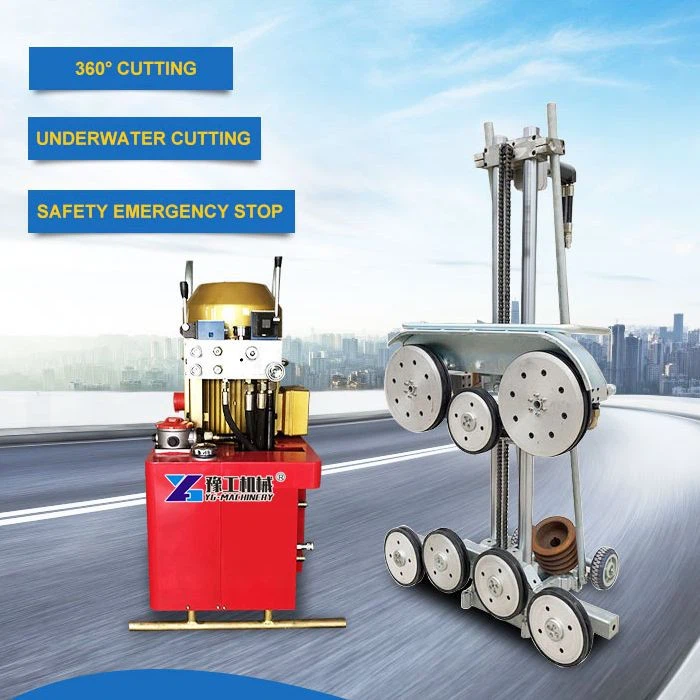
A concrete wire saw is a powerful cutting tool that uses a continuous loop of diamond-impregnated wire to slice through concrete. The wire is driven by a motor, and as it moves, the diamonds on the wire grind away at the concrete, cutting through it like a hot knife through butter. This method allows for precise and efficient cutting, even in thick or hard-to-reach areas.
One of the biggest advantages of a concrete wire saw is its flexibility. The wire can be easily threaded through small holes or around obstacles, making it ideal for cutting in confined spaces. It can also be used to cut curves and irregular shapes, something that's difficult or impossible with other cutting tools.
Comparing with Other Concrete Cutting Tools
Circular Saws
Circular saws are one of the most common concrete cutting tools. They use a rotating blade with diamond teeth to cut through concrete. Circular saws are relatively inexpensive and easy to use, making them a popular choice for small to medium-sized projects.
However, circular saws have some limitations. The size of the blade restricts the depth of cut, so they're not suitable for cutting very thick concrete. They also produce a lot of dust and noise, which can be a problem in indoor or residential areas. In addition, circular saws are less flexible than wire saws and can't easily cut curves or irregular shapes.
Demolition Hammers
Demolition hammers, also known as jackhammers, are used to break up concrete by delivering a series of high-impact blows. They're powerful tools that can quickly break up large areas of concrete, but they're not very precise. Demolition hammers are more suitable for rough demolition work rather than precise cutting.
Another drawback of demolition hammers is that they're very noisy and produce a lot of vibration, which can be hard on the operator and cause damage to surrounding structures. They also require a lot of physical effort to use, so they're not ideal for long or repetitive tasks.
Water Jets
Water jets use a high-pressure stream of water to cut through concrete. They're a relatively new technology that offers a clean and precise cutting method. Water jets produce very little dust and noise, and they can cut through a variety of materials, including concrete, steel, and glass.

However, water jets are expensive to purchase and operate, and they require a large amount of water. They also have a limited cutting speed, so they're not suitable for large-scale projects.
Advantages of Using a Concrete Wire Saw
Precision Cutting
As mentioned earlier, a concrete wire saw allows for precise cutting, even in complex shapes. This is especially important in projects where accuracy is crucial, such as in the construction of bridges, dams, or high-rise buildings.
Efficiency
Concrete wire saws can cut through thick concrete quickly and efficiently. They're designed to handle large-scale projects, and they can significantly reduce the time and labor required for cutting.
Minimal Noise and Dust
Compared to other cutting tools, concrete wire saws produce less noise and dust. This makes them a more environmentally friendly option, especially in indoor or residential areas.
Less Structural Damage
Since a concrete wire saw cuts through the concrete without applying excessive force, it causes less structural damage to the surrounding area. This is important in projects where the integrity of the remaining structure needs to be maintained.
Applications of Concrete Wire Saws
Concrete wire saws are used in a wide range of applications, including:
- Bridge and Highway Construction: For cutting and removing old bridge decks, piers, and abutments.
- Building Demolition: To cut through thick concrete walls, floors, and columns during demolition projects.
- Industrial Plants: For cutting through concrete foundations, pipes, and other structures in industrial settings.
- Underwater Cutting: Concrete wire saws can be used underwater, making them suitable for marine construction and repair projects.
Different Types of Wire Saws
We also offer different types of wire saws to meet various project needs. For example, our Diamond Wire Saw For Stone is specifically designed for cutting natural stone, while our Hydraulic Wire Saw provides high power and efficiency for heavy-duty cutting tasks.
Why Choose Our Concrete Wire Saws
As a supplier, we're committed to providing high-quality concrete wire saws that meet the highest standards of performance and reliability. Our wire saws are made from the best materials and are rigorously tested to ensure they can handle the toughest cutting jobs.
We also offer excellent customer service. Our team of experts can provide you with technical support, training, and advice on choosing the right wire saw for your project. Whether you're a professional contractor or a DIY enthusiast, we're here to help you get the job done right.
Conclusion
In conclusion, a concrete wire saw offers many advantages over other concrete cutting tools. Its flexibility, precision, and efficiency make it a top choice for a wide range of projects. If you're in the market for a concrete cutting tool, I highly recommend considering a wire saw.
If you're interested in learning more about our Concrete Wire Saw or have any questions about concrete cutting, feel free to reach out to us. We're always happy to discuss your project requirements and help you find the best solution.
References
- Concrete Cutting Handbook, Construction Industry Press
- Guide to Concrete Cutting Tools, Professional Contractor Magazine


